

Climate Action Plan
Introduction
This Climate Action Plan formalises Antica Erboristeria’s commitment to addressing the climate crisis and actively contributing to the global objective of limiting warming to 1.5°C, as outlined in the Paris Agreement and recommended by the international scientific community. It also represents the main guide for pursuing the following common benefit purpose:
Antica Erboristeria is committed to the progressive evolution of its business and operating model towards an economy with net-zero climate-altering greenhouse gas emissions, in line with European climate neutrality objectives and national ecological transition objectives.
Reference methodology
The methodology underlying this Climate Action Plan, although currently limited to the measurement of Scope 1 and 2, is based on internationally recognised standards, in particular the guidelines established by the GHG Protocol Corporate Standard, to ensure rigour, transparency and comparability.
Quantification of emissions
In 2026, Antica Erboristeria launched an analysis and reporting process that focused specifically on the following emission categories for 2024 and 2025:
- Direct Emissions (Scope 1):
These include emissions generated directly from sources owned or controlled by our organisation. Typical examples include fuel combustion in company vehicles and fugitive emissions from refrigeration systems. Our Scope 1 reporting is essential for understanding the direct impact of our operations. - Indirect Energy Emissions (Scope 2):
These emissions derive from the generation of electricity, heat or steam purchased and consumed by our organisation. Their quantification is essential because it reflects the carbon footprint associated with our energy consumption. To date, we use the location-based approach.
The total results of the analyses are reported below.
| 2024 | |
|---|---|
| Scope | tCO2e |
| Scope 1 | 15 |
| Scope 2 (location–based approach) | 35 |
| TOTALE SCOPE 1 + 2 | 50 |
| 2025 | |
|---|---|
| Scope | tCO2e |
| Scope 1 | 15 |
| Scope 2 (location–based approach) | 32 |
| TOTALE SCOPE 1 + 2 | 47 |
Commitment and reduction targets
Antica Erboristeria, in line with its membership of the CO2alizione network in 2022, pursues the European objective of reaching net-zero greenhouse gas emissions into the atmosphere by 2050 at the latest.
Recognising the importance of a holistic view of our climate impact, we are planning to extend our analysis to progressively include Indirect Value Chain Emissions (Scope 3).
The inclusion of Scope 3, which covers all other indirect emissions that occur in the company’s value chain (such as business travel, the purchase of goods and services, upstream and downstream transport, and the use of sold products), is a strategic objective to provide a complete and detailed picture of our total carbon footprint. The introduction of Scope 3 is planned for the next reporting cycle in 2027, demonstrating our commitment to increasingly responsible and forward-looking environmental management.
Antica Erboristeria’s commitment
With a view to significantly and measurably reducing environmental impact, Antica Erboristeria has undertaken a strategic and structured path in recent years, resulting in the implementation of several key initiatives.
Self-generation of energy and elimination of Scope 2 emissions (market-based approach)
One of the pillars of this strategy is the major investment in renewable energy. In particular, the installation of latest-generation photovoltaic systems stands out, covering a large part of the usable surface area of Antica Erboristeria’s production and administrative site.
This commitment has led to extraordinary results: internally generated energy covers half of the company’s energy needs, resulting in the near elimination of our Scope 2 emissions. This result underlines our leadership in adopting sustainable energy production practices.
New headquarters and sustainable building standards
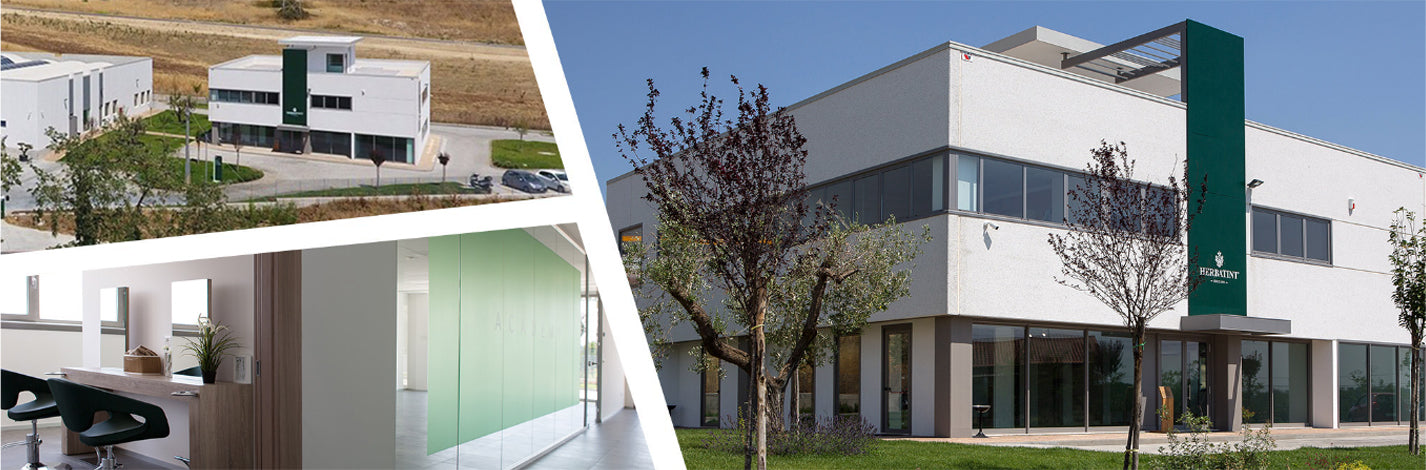
As further evidence of our dedication to sustainability, in 2017 we moved to a new operating site, designed and built according to the most rigorous international sustainability standards. The site obtained LEED certification (Leadership in Energy and Environmental Design), a recognition that attests to excellence in the design, construction and management of sustainable and highly efficient buildings.
Operational energy efficiency
The focus on energy efficiency is not limited to the building structure but permeates all operations. We have fully electrified our operations, eliminating the use of fossil fuels in production processes and internal logistics. Added to this is the choice of climate control systems with an efficient energy class and timed operation. The site uses LED lighting exclusively.
Logistics optimisation and reduced environmental impact
Among the various structural efficiency improvements aimed at minimising environmental impact, the intervention in the warehouse area was crucial. In 2023, a high-efficiency automated warehouse with mobile shelving was installed.
This system improves safety and is the result of careful analysis and mapping of goods movements, enabling all logistics to be centralised in-house while avoiding transport to external storage hubs. Thanks to this optimisation of internal logistics, we have been able to reduce handling times, minimise operational waste and ensure a low environmental impact across the entire in-house logistics chain. These combined interventions demonstrate how technological innovation is a key factor in achieving ambitious corporate sustainability objectives.
System leadership and advocacy
Antica Erboristeria recognises that achieving its climate objectives also depends on the transition of the entire ecosystem of which it is part. For this reason, the company has engaged in advocacy and collective action through the CO2alizione[1] initiative to promote more ambitious standards, involve as many actors as possible in the climate transition and enhance its leadership role within its ecosystem.
Mitigation plan
This plan formalises Antica Erboristeria’s commitment to limiting the increase in global average temperature to 1.5°C and reaching net zero by 2050 at the latest.
Carbon footprint measurement and definition of a decarbonisation scenario
Action 1: Definition of the target and development of the decarbonisation strategy
- Objective: Complete the Carbon Footprint calculation in a certifiable manner (compliance with GHG Protocol and ISO).
- Scope: Scope 3 (main focus).
- Responsible parties: Operations Management with external technical support.
- Expected Result: Define a decarbonisation scenario for Antica Erboristeria, aligned with the Science Based Target (SBTi) targets by 2026, with publication in 2027.
Energy and Efficiency
Action 2: 100% renewable electricity
- Description: Antica Erboristeria has installed a photovoltaic system on the roof of its site, covering 45% of total electricity consumption in 2025. The remaining part of the energy requirement is supplied through the purchase of electricity from certified renewable sources (Guarantees of Origin - GO), ensuring 100% electricity from clean sources.
- Category: Scope 2 (Market-based)
- Stakeholders involved: energy suppliers, maintenance team.
- Targets and timing: Maintenance of 100% electricity from renewable sources, with the objective of increasing the share of self-generation to 50% by 2027.
Mobility and Transport
Action 3: Company fleet
- Description: Maintenance of the company fleet with hybrid cars, currently 5 cars.
- Category: Scope 1 (Company fleet/Leasing)
- Stakeholders involved: assigned Antica Erboristeria employees
- Targets and timing: Continuous maintenance of 100% hybrid fleet or transition to electric vehicles.
Action 4: Route and load optimisation
- Description: Continue to enhance the commitment to reducing packaging and product weight in order to optimise loads and optimise outbound goods transport routes, maximising full truck load (FTL).
- Category: Scope 3 (Upstream/downstream transport and distribution)
- Stakeholders involved: Procurement Office and logistics partners
- Targets and timing: Target to be defined with logistics partners through engagement planned in 2028 for route optimisation.
Action 5: Preference for logistics partners
- Description: Prefer logistics partners that use vehicles with lower environmental impact for their transport, and commit to reducing air transport for goods as much as possible, except in documented emergency cases. Give preference to local and European suppliers to reduce transport distances (where possible and competitive).
- Category: Scope 3 (Upstream/downstream transport and distribution).
- Stakeholders involved: Procurement Office and logistics partners
- Targets and timing: List of preferred suppliers and distributors by 2028.
Action 6: Eco-design practices applied to product and packaging
- Description: Research and development of eco-design techniques to reduce associated impacts (Scope 3)
- How: Collaboration with raw material suppliers to increase awareness of the use of ingredients in formulations from a sustainable supply chain.
- Category: Scope 3
- Stakeholders involved: Raw material and packaging suppliers, Operations
- Targets and timing: Scouting of formulation ingredients capable of further innovating current formulations and/or new developments, favouring ingredients from certified supply chains, of natural origin and capable of giving the product added value in terms of performance by 2027.
Governance and resources
Approval and supervision
The Climate Action Plan is subject to evaluation and review by Antica Erboristeria’s Management Committee. The Management Committee reviews the Climate Action Plan annually and, if necessary, requests its update from the responsible parties (identified in the following point) to make it suitable for company and contextual changes. This mechanism may also be implemented at other times during the year, if deemed necessary.
Roles and responsibilities
The practical implementation of the mitigation actions contained in this document is the responsibility of all Antica Erboristeria employees within the scope of their specific duties and daily operations. An internal working group at Antica Erboristeria, composed of personnel with specific experience in climate impact and decarbonisation, is formally tasked with supervising the progress and implementation of the actions and the achievement of the expected results.
Allocation of resources
The company allocates part of working time to the implementation of the Climate Action Plan, assigning a budget that will be defined and allocated every year-end by the CDD, while also defining owners / resources responsible for the related activities.
Conclusion
The adoption of this Climate Action Plan marks a fundamental step in Antica Erboristeria’s path towards a net-zero emissions future.
Antica Erboristeria declares its commitment to complete, public and annual transparency for all stakeholders, including customers, employees, institutions and civil society as a whole, on all topics covered within the Climate Action Plan.
The Climate Action Plan is accessible in a dedicated section of the Antica Erboristeria website. The greenhouse gas emissions inventory, the decarbonisation actions implemented and the progress made in reducing emissions are reported annually in the Impact Report, also available on the Antica Erboristeria website.
04.05.2026
Benoit Doither, CEO